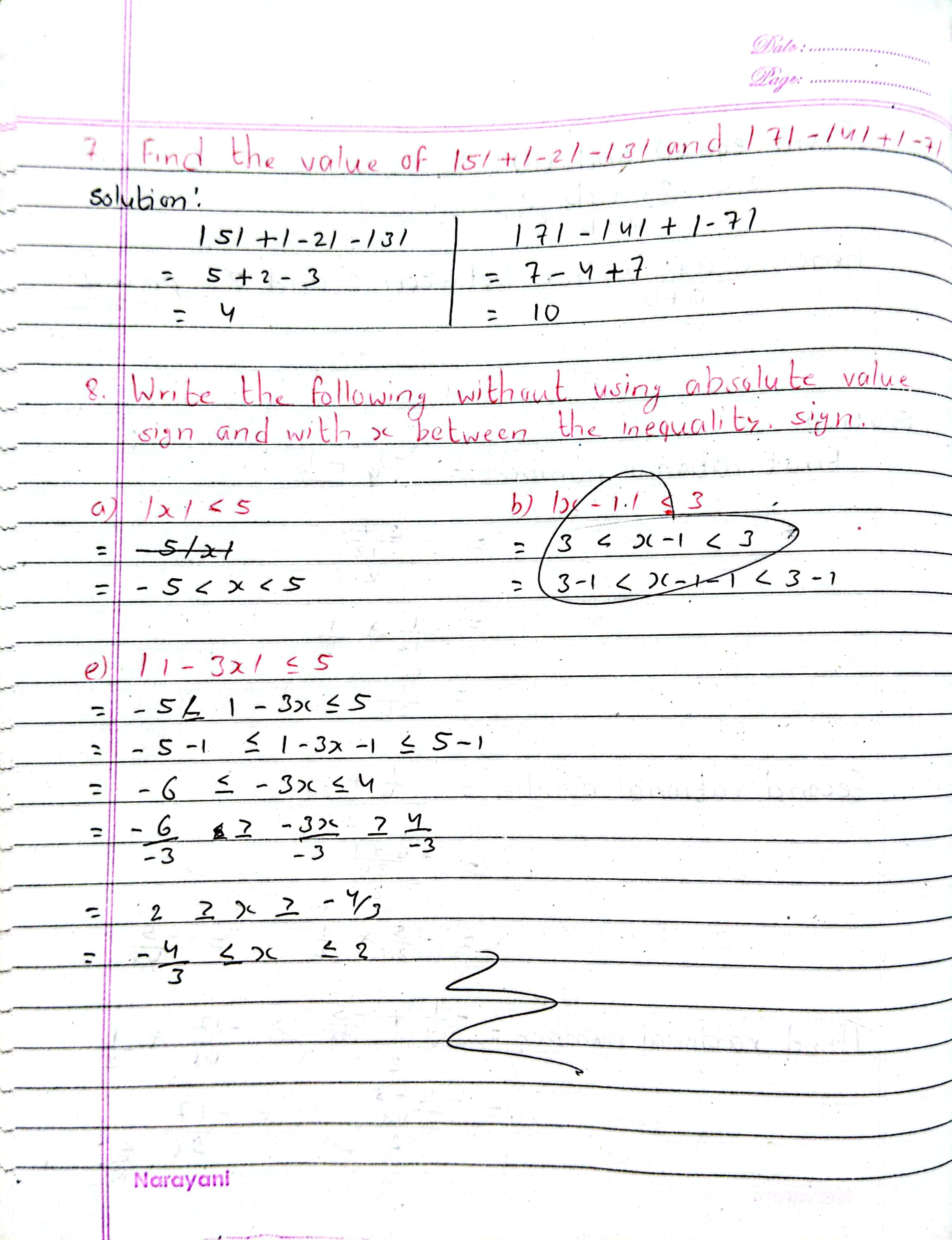
BCA Mathematics -I (Unit I Natural Number)

.


Comments

Popular posts from this blog

Important Questions of Data Structure and Algorithm (DSA)

 . 1. What is Data structure? Explain different operations to be performed on data structure. 2. Define stack as ADT. Convert P+Q-(R*S/T+U) - V*W into infix expression to postfix. 3. Define Queue. Explain its type with example. 4.  Difference between stack and Queue. 5. Difference between Linear Queue and circular Queue. 6. Write an algorithm to enqueue and dequeue data element in a circular queue.                              7. Define Linked List. Explain its type. How does double linked List is different from circular linked   List. 8. What is recursion and recursive function? write a recursive function to compute Fibonacci number. 9. What is an AVL tree ? Create an  AVL tree from the following data:      18, 12, 14, 8, 85, 25, 31, 24, 27 10. Define B-tree? How to insertion and deletions of elements can be done in a B-tree. 11. Create an B-tree from the following Data:  ...

Define LAN and WAN

 . Local Area Network (LAN)  A LAN is a network that is used for communicating among computer devices, usually within an office building or home.   LAN’s enable the sharing of resources such as files or hardware devices that may be needed by multiple users • • Is limited in size, typically spanning a few hundred meters, and no more than a mile.  Is fast, with speeds from 10 Mbps to 10 Gbps.  Requires little wiring, typically a single cable connecting to each device.  Has lower cost compared to MAN’s or WAN’s.  LAN’s can be either wired or wireless. Twisted pair, coax or fiber optic cable can be used in wired LAN’s. Advantages of LAN :    The data is transferred at an extremely faster rate in local Area Network.  Local area network (LAN) provides higher security. Disadvantages of LAN :   Initial cost of installing local area network is quite high.  Unauthorized user can access critical data of an organization in case LAN ad...

Digital signal and wave form

 . Digital Signal: A digital signal is a representation of information using discrete values, typically in binary code (0's and 1's). They have distinct levels or states, allowing for precise representation of data. Commonly used in digital communication, computers and electronic devices for transmitting and processing information. Digital signals are less susceptible to noise during transmission, making them reliable. Example: Binary-coded messages, digital audio data transmitted over the internet are all examples of digital signals. Digital Waveform: Digital waveform consist of voltage levels that are changing back and forth between the HIGH and LOW level as states. A waveform, on the other hand, is a graphical representation of a signal's amplitude as it varies with time. It shows how the amplitude of the signal changes over a specific period. Waveforms can be associated with both analog and digital signals. It used in signal processing, audio analysis and the study of e...